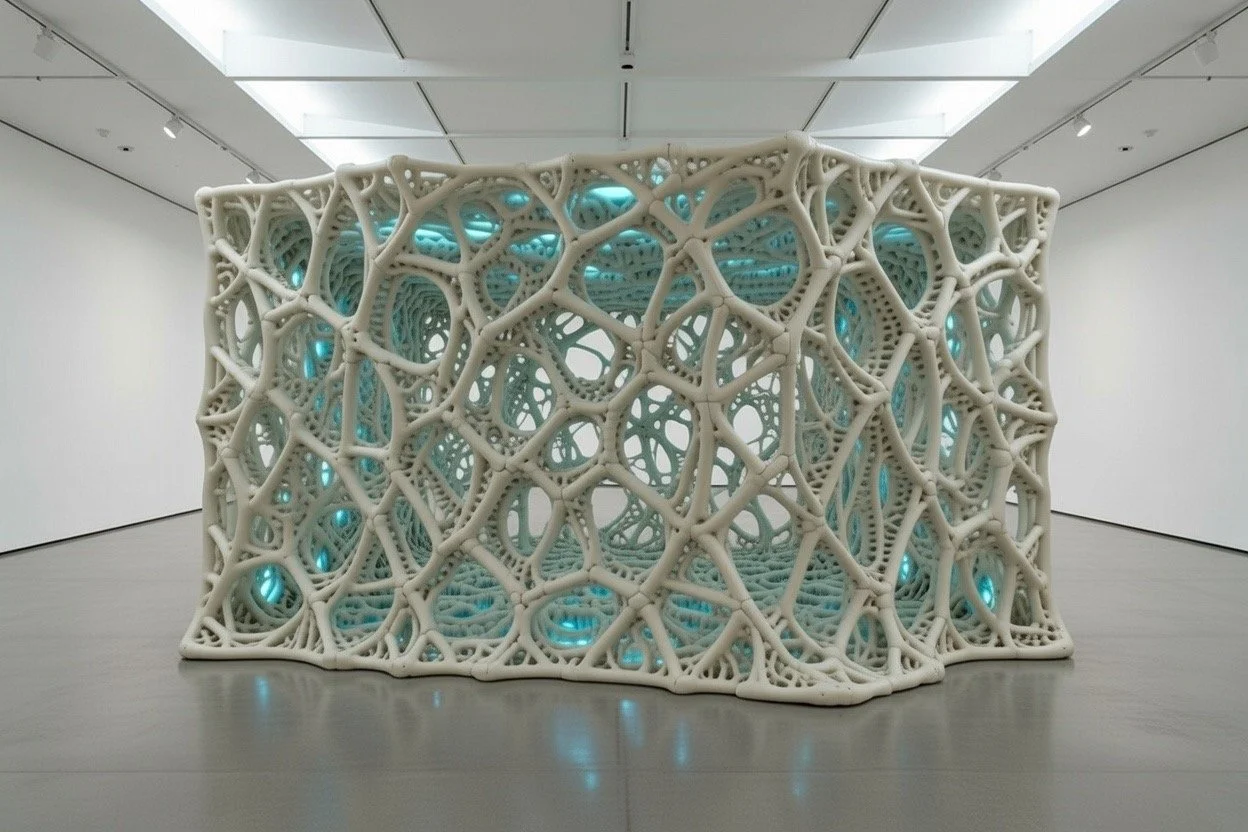
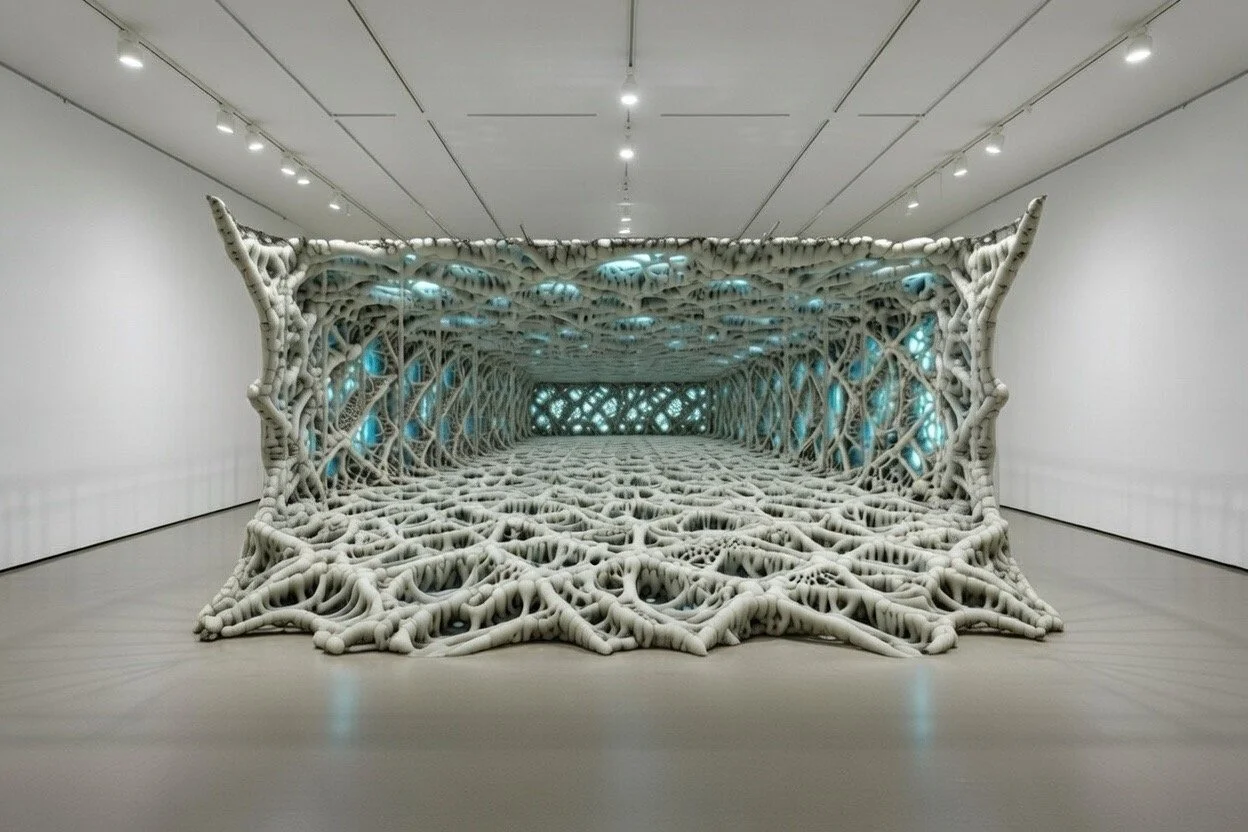
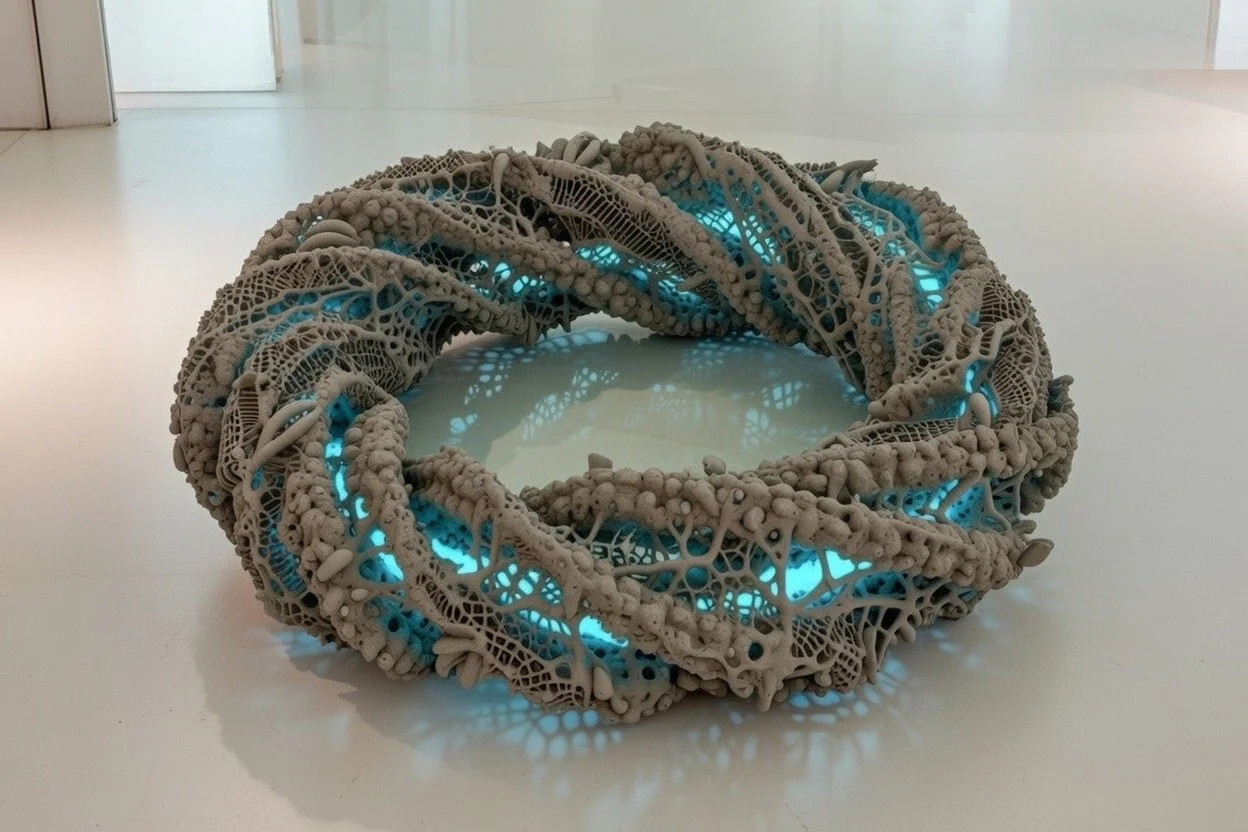
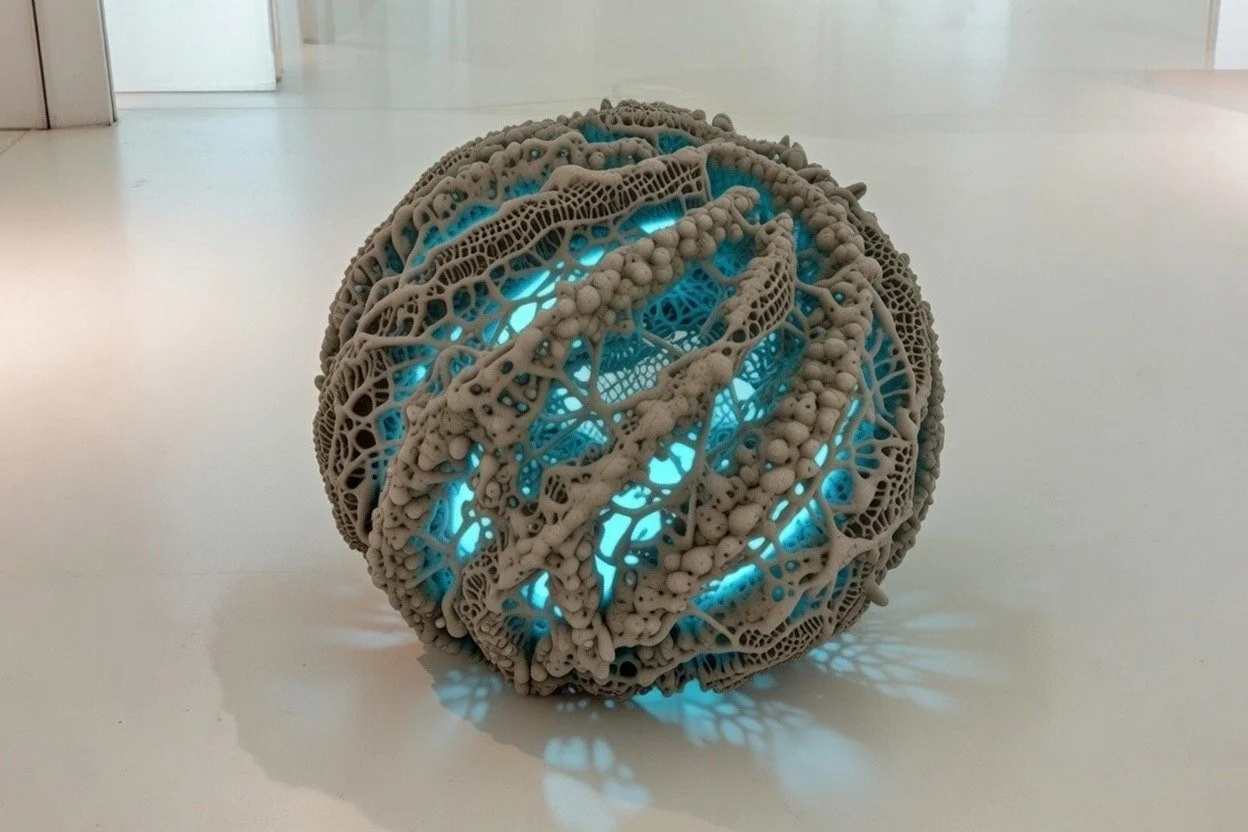
Acausal Sediments of Entangled Abiotics
is a conceptually immersive group of installations that enacts a speculative ontology of abiotic memory, interpreting epekimnesis as the non-living realm's acausal inscription of temporal disruptions caused by events such as tsunamis or erosion cycles. Transcending mimetic art, it comprises a rhizomatic network of suspended modular nodes: 3D-bioprinted geopolymer lattices infused with quantum dots and CRISPR-edited microbes that "recall" environmental stressors via phase-shifting crystallinity. Fabricated from upcycled microplastics from disaster-impacted shorelines and doped with piezoelectric nanoparticles, these nodes exhibit acausal synchrony via simulated Bell-nonlocal correlations, triggered by inputs such as seismic simulations.
Visitors engage via neural interfaces, contributing subconscious theta waves to a quantum annealing algorithm that retroactively erodes augmented reality projections of virtual stones, blurring observer and system in emergent temporality. Additional elements include hydroponic vats of aerogel-embedded seawater crystals forming inverting fractal patterns based on global tide data; self-assembling sculptures from salvaged debris (e.g., Fukushima or Indian Ocean relics) that disassemble under UV; time-reversed tsunami acoustics for auditory illusions; and phosphorescent fungi luminescing in response to geomagnetic shifts, casting evolving topological shadows.
Materials emphasize epekimnetic potential: quantum-entangled photonic crystals for signaling, shape-memory alloys from deep-sea vents for pressure recall, and AI-orchestrated microdrone swarms depositing stochastic sediment layers integrated with blockchain climate data. Fabrication prioritizes metamaterials such as MXene composites for electromagnetic "ghosting," biosynthesized organosilicon polymers from silicate bacteria for accretion, and edge-computing diffusion models trained on paleoclimatic datasets for autonomous evolution. Ethically sourced from post-disaster reclamation, the work critiques causality, positioning the abiotic as a hyperobject that arches the uncaused and the recursive in a post-Anthropocene framework.