Molybdomancy
Performance
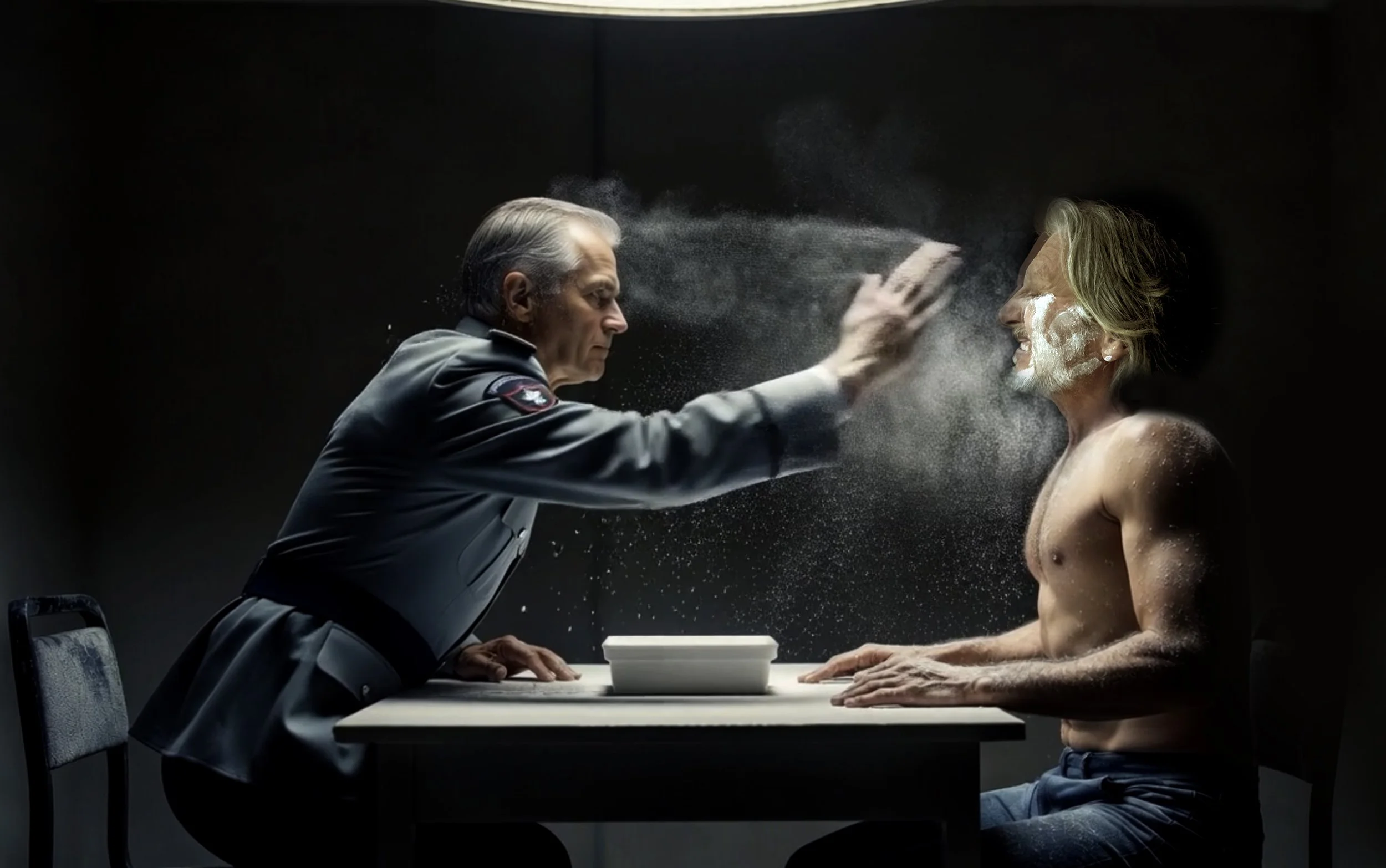
In a semi-darkened room lit like a late-night interrogation chamber, two figures sit at a bare table, viewed strictly from the side in the flattened, diagrammatic perspective of a chess match. On one side: the artist, bare-chested, skin exposed, no protection. Opposite him: a fully uniformed official in crisp grey-blueish regulation dress, every detail of the bureaucratic armor in place. On the sleeve, a circular black-and-red insignia of a state power structure. Between them rests a single, cheap white styrofoam box filled with lead oxide powder — the exact substance that still leaches into water systems, alongside mercury, heavy metals, PCBs, microplastics, and the residues of oil spills, worldwide.
For thirty minutes, the artist speaks thirty words, only one word every minute — “Water.” “PBC," “Cancer," “Plastics,” “Future...” — each utterance met with the official’s polite smile, a hand dipped into the powder, and a powerful slap across the bare face. White dust explodes in slow-motion clouds, settles, and accumulates in deliberate layers across skin, hair, and torso until the artist’s upper body becomes a living, luminous monument of punished language.
This is endurance performance distilled to its most economical and brutal form: no narrative, no explanation, no petition. The ritual enacts the precise mechanism by which institutional power responds to any naming of systemic violence — with the very contaminants it has already embedded in the water we drink, the rivers we swim in, and the rain that falls. The lead oxide is not a metaphor; it stands for every heavy metal, every persistent pollutant the modern state has allowed to circulate while maintaining the appearance of control. The slap is not theatrical; it is procedural. The accumulating dust turns the citizen’s body into an involuntary archive of the words that were never permitted to remain clean.
Molybdomancy operates at a high level of formal restraint and conceptual clarity. Its visual economy produces an image of immediate and lasting power, while the one-word litany transforms individual speech into a site of repeated, polite violence. By fusing the ancient Greek root for lead (μόλυβδος molybdos) with the suggestion of dominion and dependency, the title and the insignia locate the work beyond any single environmental scandal. It addresses a broader, timeless condition: the way any governing apparatus responds to inconvenient language with the toxin it has already delivered into its citizens' bodies. In doing so, the piece achieves a quiet yet profound transcendence, speaking with equal force to audiences who have never encountered the specific acronyms or statistics. This is a rigorously controlled and deeply original performance of rare urgency.