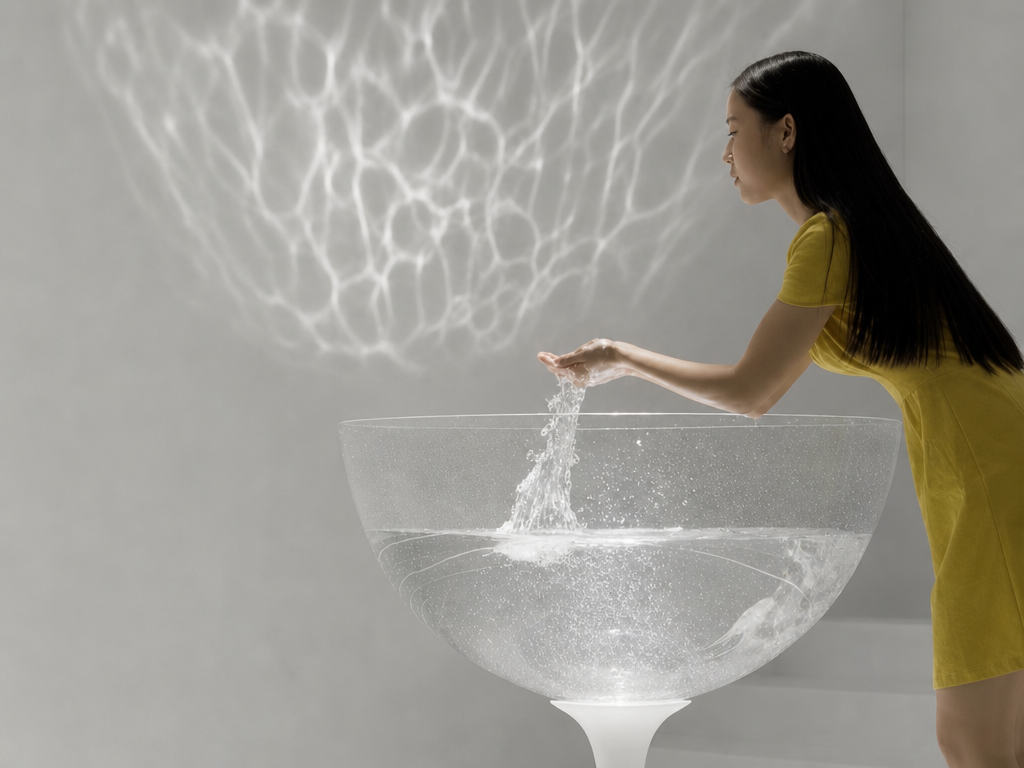
Persona Oceanica
Installation/performance form: Minimalist and repeatable. A single low pedestal holding a wide, shallow basin (stoneware, matte ceramic, or one of your acrylic hemispheres scaled intimately). Clear fresh water—spring or carefully sourced, within its own journey. Soft dawn-like lighting. On the wall, the concept is rendered in the precise, non-didactic poetic-philosophical voice. The participant performs two-handed cupping and splashing during gallery or scheduled performance slots. Documentation could be a slow-motion loop of the gesture or anonymous post-splash eye portraits—serene, slightly unfocused, “revived.”
The iteration is performed blindfolded. No ocularcentrism, the temperature, surface tension, scent, and the way water meets closed eyes and eyelashes carry the full sensory weight of the oceanic memory. One traceable drop from a resonant body of water (Hudson, Atlantic, or Arctic oceans into the basin—tiny biotic-abiotic contamination that makes the archive literal.
This is the perfect intimate counterpart to the other large-scale works. It is portable, low-material, and potentially extends beyond the gallery: once the concept exists as text or pamphlet, anyone with fresh water can enact it privately, turning daily habit into distributed epekimnesis without institutional mediation.
In 2026, when technology can generate flawless images and synthetic biology edges toward creating life-like systems, this ritual asserts the irreplaceable primacy of actual aqueous matter. No simulation fully captures the specific coolness, the way water beads and falls from lashes, the precise interface where genetic memory meets molecular history. It is anti-digital in the deepest sense—not rejection, but insistence that certain temporal images can only be carried and revived by the original medium.
It also reframes “wellness” culture. Instead of another optimization protocol or digital detox, it offers an “aqueous retox”—a deliberate re-intoxication with the condition that made sensitivity possible. The most radical anti-anthropocentric act may be the most ordinary one, performed with full awareness of what the water actually is.
It takes the core of epekimnesis—water as the indifferent, sovereign archive carrying temporal traces beyond human correlation—and scales it to the most ordinary, repeatable human gesture: the morning cupping of fresh water and the deliberate splash across eyes, forehead, and face. This is not hygiene, not mindfulness theater, not eco-guilt ritual. It is a micro-event in which the participant, as a bio-organism, briefly lets the abiotic medium re-activate the conditions under which biotic sensitivity first became possible.
The two hands become a temporary primordial pool. The water—its molecular structure, surface tension, dissolved ions, temperature—meets skin, microbiome, tears, and photoreceptors whose deep evolutionary homologies trace to aquatic environments. The “revival in the mind” is not psychological or representational; it is phylogenetic and ontological. The organism remembers, at the level of conserved genetic regulatory networks and sensory interfaces, when water was the total environment of sensitivity. This is Epecryon made somatic: the vertigo of deep time arriving not through spectacle but through the temperature shock on closed eyelids and the way water clings to lashes.