THE SUBJECT CAGE
Performance
On the bridge over the Hao River, Zhuangzi looked down at the minnows and said they were happy. Huizi asked how he could know the fish were happy when he was not a fish. Zhuangzi replied by asking how Huizi could know what Zhuangzi himself did or did not know. They remained standing there above the water. Neither convinced the other.
What the exchange made visible was not a disagreement over knowledge, but the shared position from which both men spoke: upright, facing downward, treating the movement below as something that could be known or refused. This position is what I call the Subject Cage.
The Subject Cage is the living architecture formed by the body, identity, desire, and anthropocentric thought, whose primary operation is to convert the indifferent movement of the more-than-human into contents that can be observed, known, felt, or possessed by a self. It does not merely separate the human from what is not human. It produces the very division between observer and observed, and then presents that division as natural.
The body supplies the material surfaces capable of turning and facing. Identity supplies the ongoing claim that these surfaces belong to a continuous “I.” Desire supplies the tension that keeps this claim urgent. Anthropocentric thought supplies the grammar that makes the whole arrangement appear necessary. Together, they form a cage that does not sit around the subject. The subject is the cage.
Unlike many artistic works that use the image of the body as a cage — whether as a political metaphor or an existential symbol — the Subject Cage is not presented here as another visual metaphor. It is not a material construction. It names the ontological operation through which any subject appears: the specific way a body, an identity, and a desiring attention convert the more-than-human into something that can be observed or possessed.
A glass of water held near the lips already contains water that once moved through other bodies and produced other thoughts. The same water moves through the planet and returns toward what it was before any organism tried to organize it around a self. The thought that this water inside the glass is continuous with the water that once formed another person’s thinking is usually met with immediate refusal. This refusal is not only intellectual. What I have called vertigo is the body’s somatic registration of the threat: the endolymph reacts to the proximity of water that was never arranged to serve as the interior of a subject.
The cage is not added to an originally free nature. It is the specific way a body made of water attempts to stabilize itself against its own liquidity. The men on the bridge did not simply observe the minnows. They converted the movement of water and fish into a scene whose meaning was partly decided by the fact that they were standing above it. The minnows do not require this conversion. Their movement does not complete itself in any subject’s recognition. Water does not observe, does not desire, and does not need anything to appear as its content or its opposite.
When the cage is recognized as made of the same water it tries to hold at a distance, its function begins to shift. The body no longer needs to operate first as the architecture that must enclose in order to relate. It can become a surface through which water passes without being forced to serve as the interior of anything. The colored birds that once moved inside the structure formed by the shoulders and torso do not become free when the bars disappear. They become present in a relation that no longer requires their enclosure in order to be thinkable.
Epekimnesis is the name I give to the practice that follows from this recognition. It does not ask the subject to accept a difficult truth or to enter into better relations with the more-than-human. It asks that the primary operation of the body and thought cease to be the stabilization of an observer position from which everything else must be secured as content. Traces are allowed to appear without first being completed in the act of recognition. The vertigo that sometimes accompanies this thought is not the failure of the subject. It is the cage momentarily failing to hold what it is made of.
Artist Statement about "The Subject Cage"
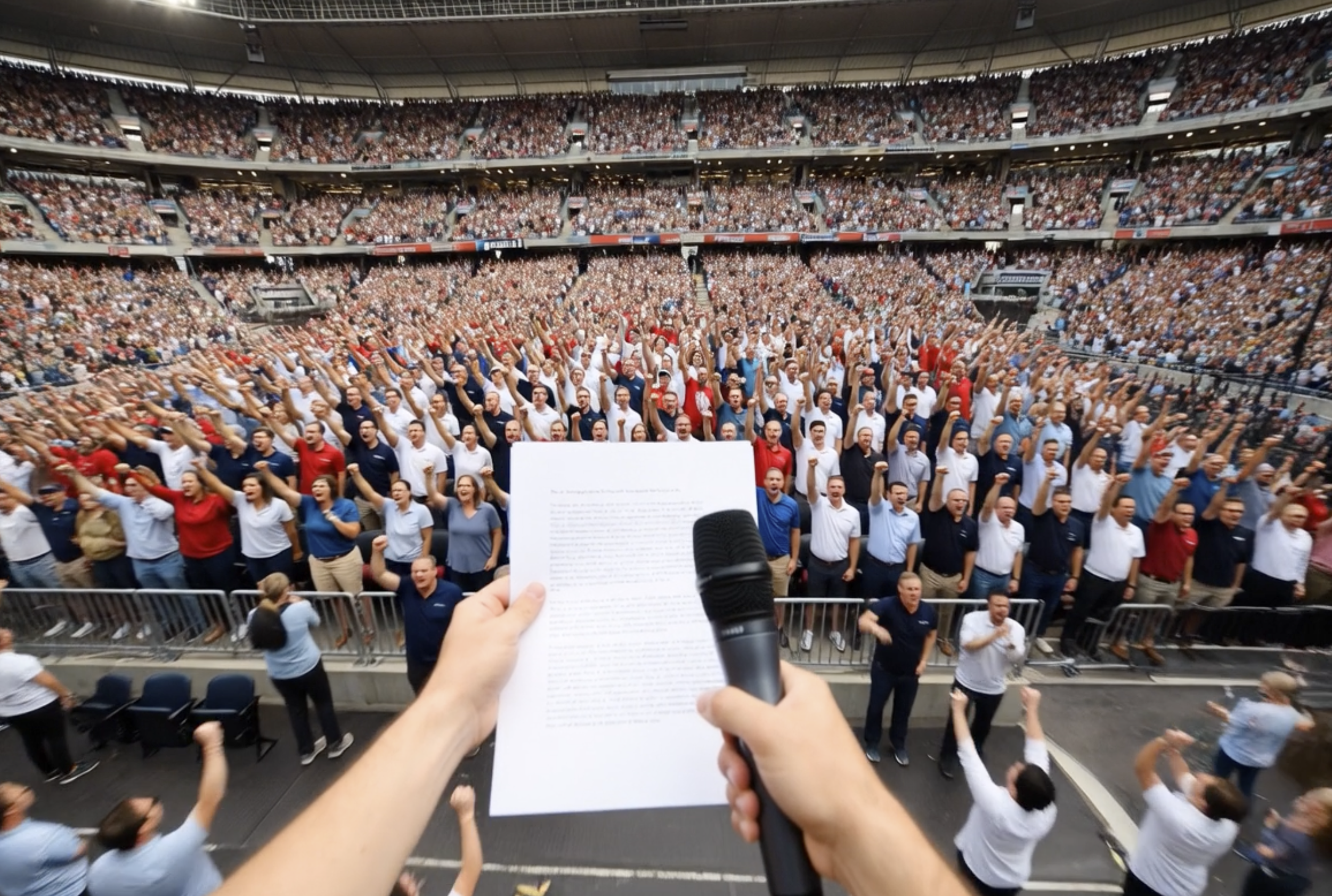
The artwork titled The Subject Cage does not take the form of objects, sculptures, or installations. It is a voice work. Its sole material is the public reading of this text.
In one realization of the work, the reading takes place inside a full stadium. The architecture of the stadium — its massive enclosing structure, its capacity to contain, organize, and hold thousands of people within fixed positions — functions as the visible image of the Subject Cage. The audience seated in the stands becomes part of this image: bodies arranged and contained by the architectural cage. The voice reading the text emerges from the center of this enclosure, speaking about the very structure that contains both the speaker and the listeners.
This is not a theatrical performance or a spectacle. There is no stage design, lighting, or additional visual elements. The artwork consists only of the voice delivering the text from within the cage. The stadium is not used as a neutral venue. It is used as the cage itself — a contemporary, monumental manifestation of the same operation the text describes: the conversion of living presence into positioned, observable content inside a containing structure.
By reading the text within this architectural and social cage, the work renders the Subject Cage momentarily visible as both a philosophical claim and a physical, collective reality. The voice does not stand outside the cage to describe it. It speaks from within.
_______