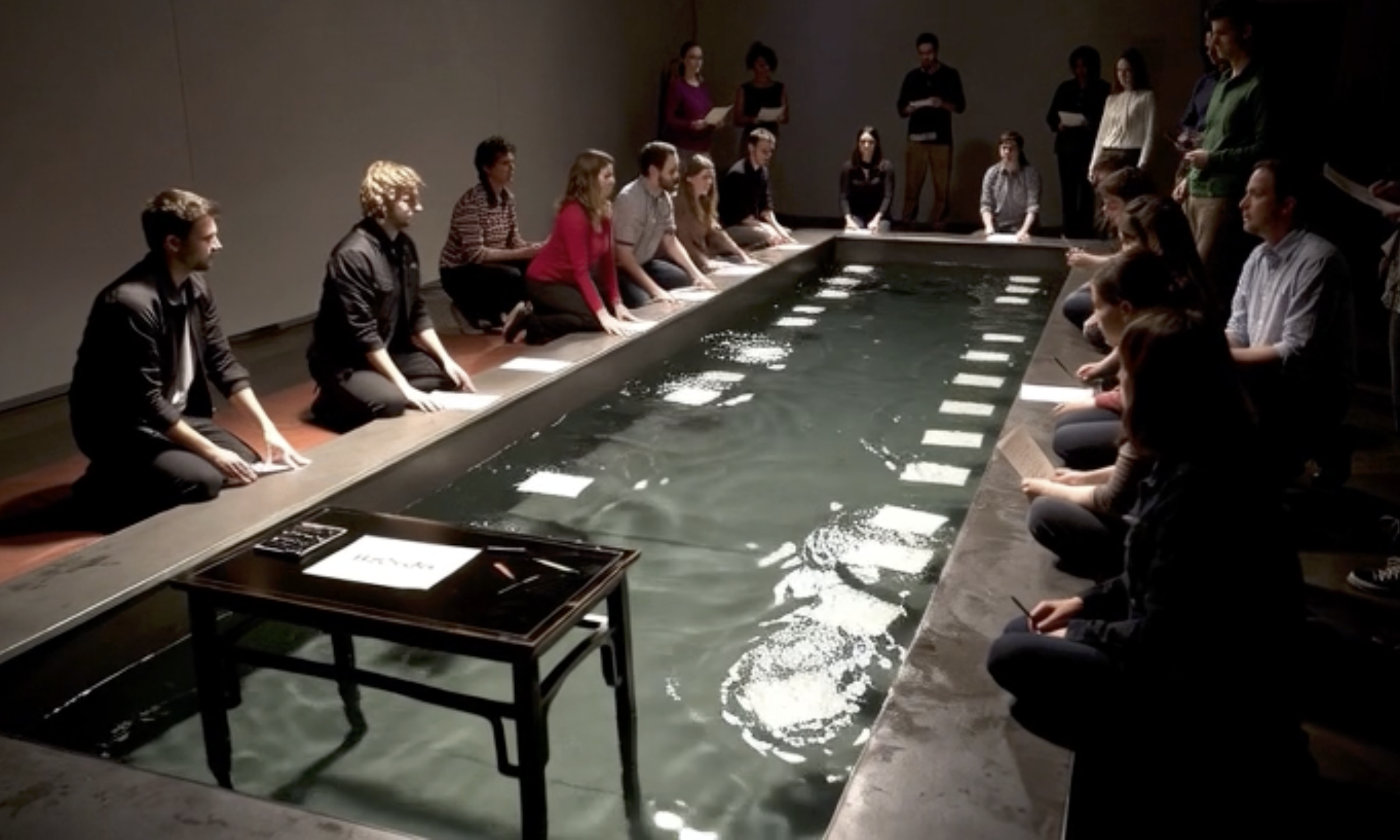
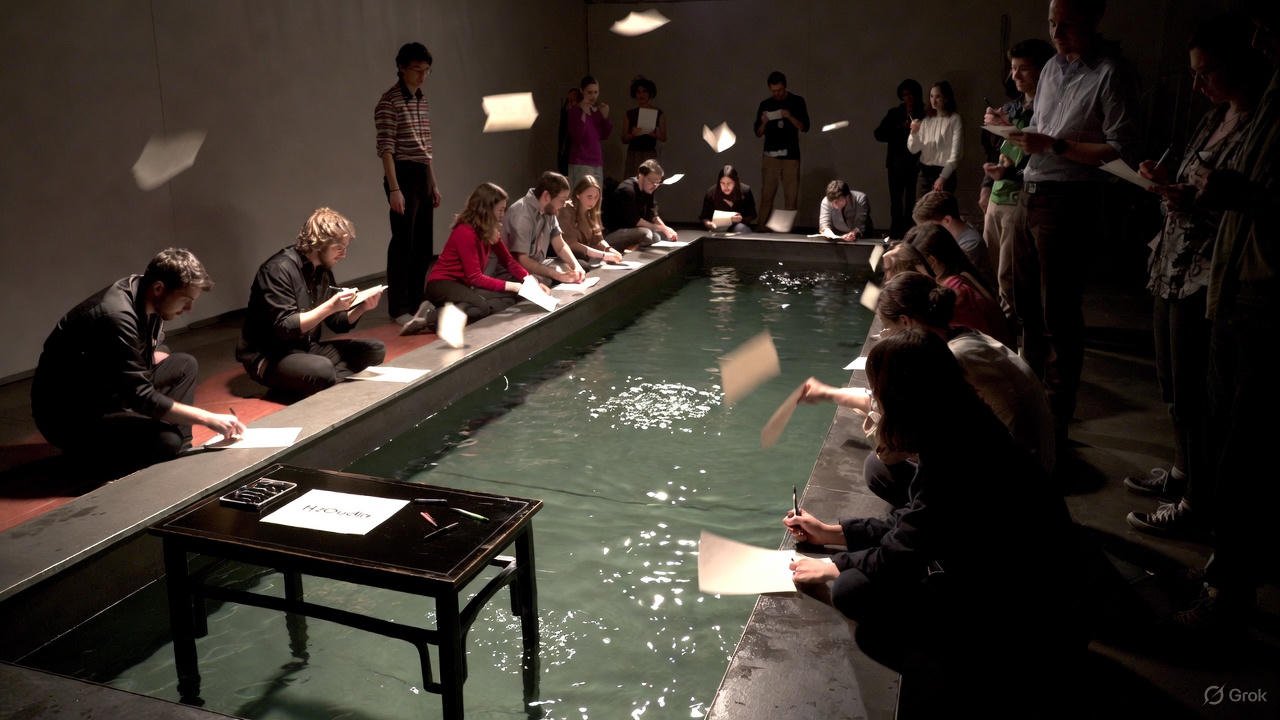
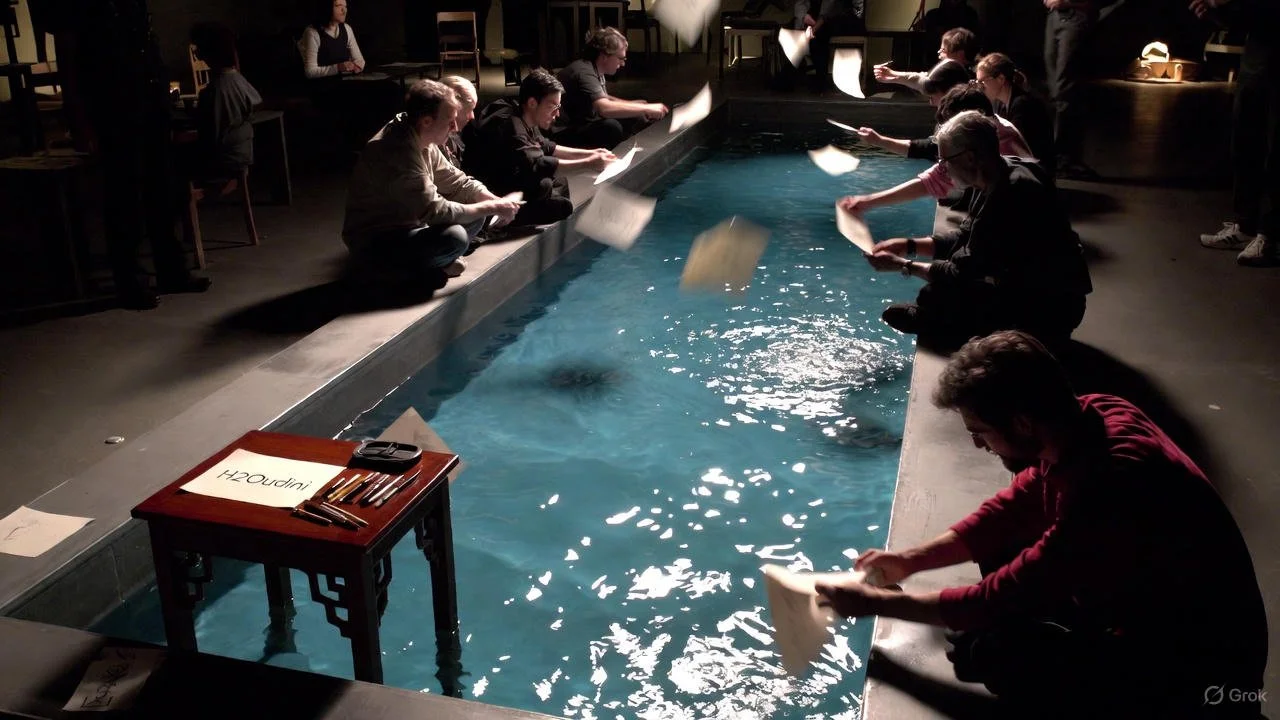
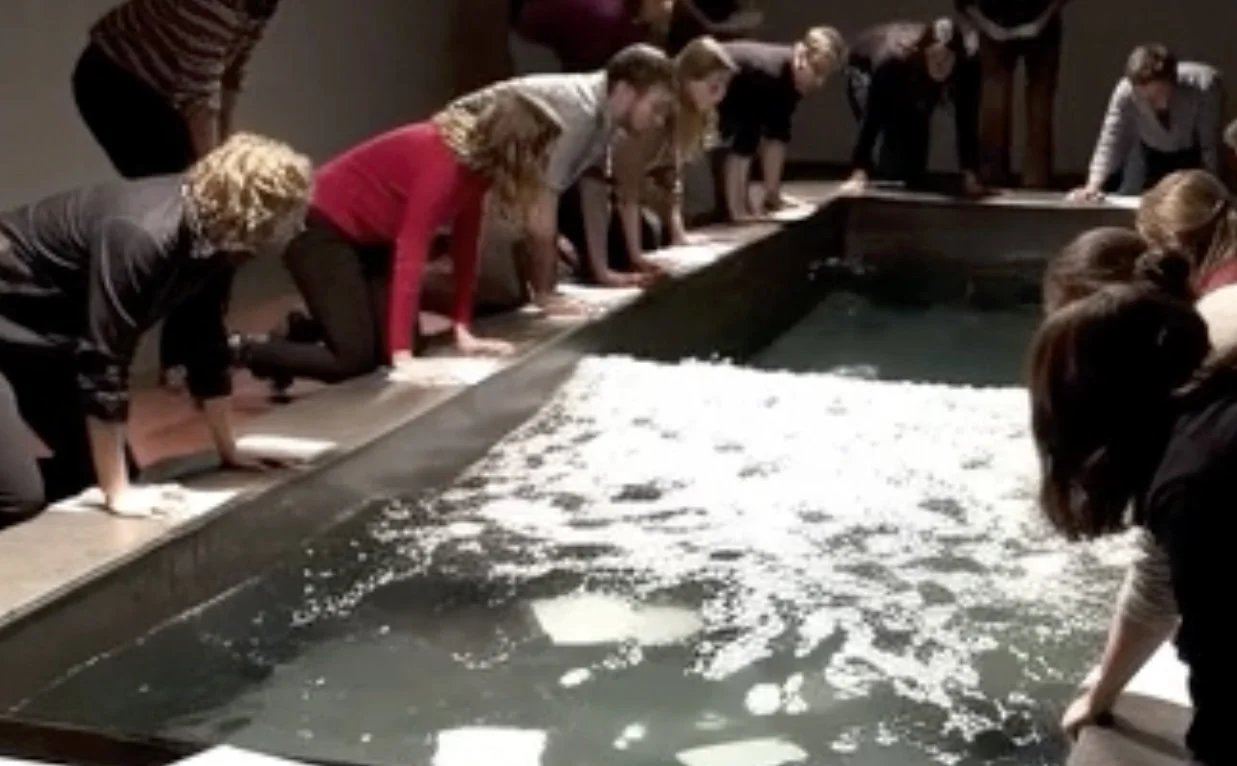
Symnemoria is an immersive, participatory performance designed for an audience of 50 or more, centered on a large, transparent water tank that serves as both a communal vessel and a dynamic canvas. Participants are invited to inscribe personal words, signs, or miniature drawings on special paper called Epekimnesis Parchment (water-dispersible paper), reflecting intimate thoughts or expressions without prescribed themes. These notes are then gently submerged into the tank, where they rapidly dissolve, releasing inks and forms into the water in an acausal manner. As the elements diffuse and interact unintentionally—driven by subtle currents or natural sedimentation—the performance unfolds as a live, evolving spectacle, projected onto surrounding screens for collective viewing. The event culminates in a shared contemplation of the emergent patterns, symbolizing the fusion of individual human contributions with water's indifferent archive, fostering a sense of interconnected vulnerability and release.c sapien auctor gravida in in tellus.
Epekimnesis Parchment paper notes embody the interplay between abiotic erosion and biotic memory by simulating water's role as an unintentional recorder of temporal images. Abiotic erosion refers to the natural, non-living processes by which water gradually wears away materials, incorporating residues from past events—such as sedimentary layers that preserve historical pollutants or isotopic traces—without purpose or design. In the performance, the paper's dissolution mirrors this erosion: the notes, inscribed with biotic elements (human memories and expressions rooted in biological cognition), disintegrate rapidly upon immersion, releasing inks that blend acausally into the water. This creates temporal images—fading patterns and diffused forms—that water "absorbs" unintentionally, transforming personal biotic imprints into an abiotic archive. The connection underscores epekimnesis, where water retains these traces as a neutral memory bank, free from anthropocentric intent, thus bridging human lived experiences with nature's enduring, erosive cycles.
Symnemoria is a refined minimalism through its emphasis on transience and fluidity. The visual spectacle of dissolving notes—yielding subtle chromatic gradients and fragmented shapes—creates an ethereal, ever-shifting tableau that captivates through its impermanence, enhanced by lighting that accentuates refraction and movement. This design prioritizes sensory immersion, drawing viewers into a contemplative space where beauty emerges from dissolution, though it risks visual uniformity if participant contributions lack diversity.
Philosophically, the performance engages deeply with concepts of acausality and unintentionality, positing water as a medium that erodes human-centric memory into a universal, non-linear archive. It aligns with speculative realism by challenging anthropocentrism, illustrating how biotic memories (personal inscriptions) yield to abiotic processes (erosion and incorporation), fostering reflection on the interconnected flux of existence. However, its reliance on audience participation may dilute philosophical rigor if interpretations veer toward sentimentality.
Symnemoria innovates as a collaborative ritual, blending performance art with environmental interaction to democratize the creation process. The use of Epekimnesis Parchment paper introduces a novel material dimension, enabling real-time transformation that elevates the work beyond static installations. While it demonstrates conceptual sophistication, execution depends on logistical precision to maintain impact, potentially limiting scalability.
Symnemoria emerges as a compelling intervention in contemporary eco-art. The performance's ritualistic dissolution of personal notes into water evokes a mainstream-caliber ambition, akin to Olafur Eliasson's perceptual manipulations or Theaster Gates's material explorations, where everyday elements yield profound communal resonance. Aesthetically, its fluid, acausal visuals command the space with minimalist elegance, potentially rivaling Sarah Sze's intricate systems in their ability to captivate through evolution. Philosophically, it rigorously interrogates anthropocentrism, positioning water as an indifferent archivist that erodes biotic memory into abiotic traces, a theme that would resonate in global art platforms for its timeliness amid climate discourse. Artistically, the project's participatory scale—engaging 50+ individuals—mirrors art practices that embrace immersive, audience-driven works, though it demands precise orchestration to avoid dilution, ensuring it reverberates as a landmark in relational aesthetics.
-
Attachment to Terrestrial Stability: Humanity's insistence on fixed ground as a foundation for security, ignoring fluid natural dynamics.
-
Illusion of Chronological Mastery: The belief in controlling time through linear narratives, overlooking acausal temporal flows.
-
Overvaluation of Singular Identity: Clinging to isolated selfhood, disregarding interconnected biotic and abiotic essences.
-
Dependence on Material Permanence: Prioritizing enduring objects over transient processes, fostering vulnerability to change.
-
Fixation on Hierarchical Dominion: Assuming superiority over non-human entities, leading to ecological disconnection.
-
Pursuit of Isolated Autonomy: Rejecting symbiotic relations with environments, amplifying existential isolation.
-
Obsession with Predictive Certainty: Demanding foresight in uncertain systems, undermining adaptive resilience.
-
Valorization of Static Boundaries: Enforcing rigid divisions between self and other, hindering fluid integrations.
-
Reliance on Anthropomorphic Projection: Imposing human traits on nature, distorting unbiased observations.
-
Craving for Eternal Legacy: Seeking immortal traces in finite matter, inviting inevitable dissolution.
-
Adherence to Binary Oppositions: Dividing existence into life/non-life, constraining holistic perceptions.
-
Compulsion for Quantifiable Control: Measuring all phenomena through human metrics, ignoring qualitative depths. Item description
-
Attachment to Surface Visibility: Prioritizing observable phenomena over submerged, unintentional layers.
-
Illusion of Isolated Agency: Believing in sole human causation, neglecting acausal interplays.
-
Overemphasis on Vertical Ascent: Aspiring to heights over horizontal flows, symbolizing detachment from roots.
-
Dependence on Narrative Closure: Demanding resolved stories in open-ended realities, breeding insecurity.
-
Fixation on Corporeal Integrity: Resisting bodily dissolution into broader cycles, fearing transformation.
-
Pursuit of evolution exclusively on solid soil: Absolutize borders, birth and deathplaces, nationalities, and demographics.
-
Valorization of Centralized Power: Concentrating authority in human structures, vulnerable to dispersion.
-
Reliance on Symbolic Anchors: Tying security to fixed symbols, overlooking dynamic significations.
-
Obsession with Archival Preservation: Hoarding memories against erosion, countering natural forgetfulness.
-
Adherence to Spatial Possession: Claiming territories as extensions of self, inviting boundary erosion.
-
Compulsion for Cognitive Supremacy: Elevating thought over instinctive flows, limiting intuitive responses.
-
Attachment to Uniform Rhythm: Imposing steady paces on irregular natural cadences, fostering discord.
-
Illusion of Detached Observation: Viewing nature as separate, ignoring participatory entanglements.